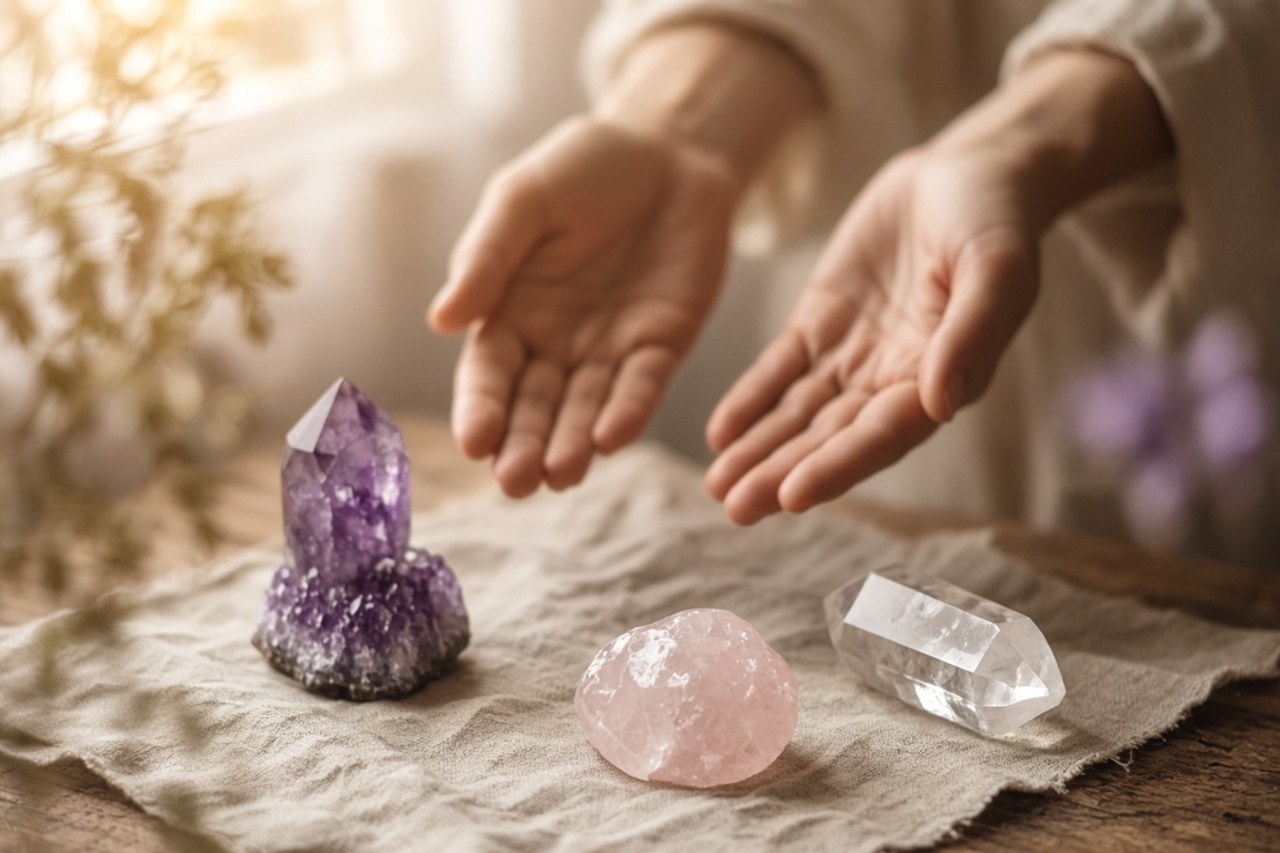
Many people exploring Reiki for the first time notice crystals placed around the treatment space or positioned on the body during sessions. While crystals are not a traditional or necessary component of Reiki practice, they have become a popular complementary tool that some practitioners choose to incorporate. Understanding the relationship between crystals and Reiki can help you make informed decisions about your own practice or sessions.
Crystals and Reiki: Separate but Compatible
It’s important to understand that crystals are not part of traditional Usui Reiki. Mikao Usui, the founder of Reiki, did not include crystal work in his teachings, and many Reiki practitioners work effectively without ever using stones or minerals. Reiki itself is complete as a practice and doesn’t require enhancement through additional tools.
That said, both Reiki and crystal work fall under the broader umbrella of complementary wellness practices, and many practitioners find they pair naturally together. Each has its own history, methodology, and theoretical framework, but they share common ground in their intention to support wellbeing and promote relaxation.
Why Some Practitioners Use Crystals
Practitioners who incorporate crystals into their Reiki sessions typically do so for several reasons. Some find that crystals help create a calming, intentional atmosphere in the treatment space. The visual beauty and natural qualities of stones can enhance the peaceful environment that supports deep relaxation during sessions.
Others work with crystals based on traditional associations between different stones and various intentions or areas of focus. For example, rose quartz is often associated with emotional comfort, while amethyst is connected to mental calm. These practitioners may place specific crystals on or around the body in conjunction with Reiki hand positions, viewing them as complementary rather than essential to the energy work.
Some practitioners appreciate crystals as focal points for intention-setting, using them as physical reminders of the healing intention held during a session. The act of selecting and placing crystals mindfully can become part of the practitioner’s own centering and preparation process.
Common Ways Crystals Are Used in Reiki Sessions
When crystals are incorporated into Reiki practice, there are several typical approaches. Some practitioners create a crystal grid around the treatment table, placing stones at the corners or cardinal points of the space. This is intended to establish a contained, intentional field for the session without the stones touching the client’s body.
Others may place crystals directly on or near the body during treatment, often corresponding to the chakra system or areas where the client has requested focused attention. The stones might remain in place throughout the session while the practitioner performs Reiki, or they might be used only during specific portions of the treatment.
Some practitioners offer crystal selection as an intuitive exercise for clients, allowing them to choose stones they feel drawn to before the session begins. This can be a gentle way to help clients engage with their own intuition and become active participants in their session experience.
What Clients Should Know
If you’re receiving Reiki sessions, you should never feel pressured to include crystal work if it doesn’t resonate with you. A skilled Reiki practitioner will always respect your preferences and can offer equally effective sessions with or without additional tools.
When booking a session, it’s perfectly appropriate to ask whether the practitioner uses crystals and to request a session without them if you prefer. Similarly, if you’re interested in experiencing crystal work alongside Reiki, you can inquire whether this is something the practitioner offers.
Remember that neither Reiki nor crystal work should be used as a substitute for medical care. These are complementary practices that may support your overall sense of wellbeing and relaxation, but they don’t diagnose or treat medical conditions. Always maintain your relationship with qualified healthcare providers for medical concerns.
For Practitioners Considering Crystal Work
If you’re a Reiki practitioner considering whether to incorporate crystals into your practice, start by examining your own motivation and comfort level. There’s no requirement to use crystals, and their absence doesn’t diminish the value of the Reiki you offer. Some of the most respected Reiki practitioners work solely with traditional methods.
If you do choose to work with crystals, invest time in learning about them separately from your Reiki training. Study the geological properties of different stones, familiarize yourself with traditional and cultural associations, and develop your own relationship with any crystals you plan to use professionally.
Always maintain clear communication with clients about what you’re using and why. Explain that crystals are an optional addition, not a core component of Reiki. Be transparent about the fact that crystal work, like Reiki itself, is a complementary practice not supported by conventional medical evidence, though many people find both helpful for relaxation and stress relief.
Keep your crystal work simple and intentional rather than elaborate. The focus should always remain on the Reiki practice itself, with crystals serving as subtle complements if used at all.
Respecting Both Traditions
When working with both Reiki and crystals, it’s valuable to respect each tradition on its own terms. Reiki has its own lineage, principles, and methodology. Crystal healing has its own rich history spanning many cultures and traditions. Neither needs the other to be valid or effective.
Some practitioners maintain clear separation, offering Reiki sessions and crystal sessions as distinct services. Others integrate them seamlessly while acknowledging they’re drawing from different wells of tradition. What matters most is practicing with integrity, clarity about what you’re offering, and respect for the client’s experience and preferences.
Finding Your Own Approach
Whether you’re a practitioner or a client, the question of crystals in Reiki practice is ultimately about personal resonance and preference. There’s no single right answer, and different approaches can be equally valid and effective. The key is to remain true to the core principles of Reiki—compassion, integrity, and service—while respecting your own intuition about what supports your practice or your healing journey.
As with all aspects of complementary wellness practices, the relationship between Reiki and crystals invites us to stay curious, open-minded, and grounded. By understanding that crystals are an optional addition rather than a requirement, we can make informed choices about our practice and sessions. What matters most is not whether crystals are present, but whether the overall experience supports relaxation, intention, and the gentle opening to our own inner resources for wellbeing. Let your practice be guided by what genuinely serves you and those you work with, knowing that Reiki itself provides a complete and time-honored path to supporting the body’s natural capacity for balance.
Recommended Reiki Tools
- Reiki Healing Crystals
- Tibetan Singing Bowls
- Reiki & Energy Healing Books
- Meditation Cushions & Candles
As an Amazon Associate, Reiki Works earns from qualifying purchases.
Advertisement
Your ad could be here — Advertise on Reiki Works